

When a number is allowed to appear
Min-N.
Min-N is the minimum number of verified answers a card must collect before its aggregate can be shown to anybody. Below that line you see nothing at all — not a partial count, not an estimate, not a figure with a warning attached. The card simply stays closed until enough real people have answered it.
Why a threshold at all.
A percentage carries no information about how many people it came from. Sixty per cent from six people and sixty per cent from six thousand look identical on a screen, read identically in a sentence, and feel identical to somebody deciding what to believe. The figure itself cannot warn you, so something outside the figure has to.
This matters more on Democrez than on most platforms, because the number you meet is the thing you are being asked to update against. You committed to a prediction; then a figure arrives and tells you how wrong you were. If that figure is noise, you have been given a false correction — and a false correction is worse than none, because you will carry it.
Why silence and not a caveat
The obvious alternative is to show the figure with a note: based on a small number of responses. We do not, for a reason that is easy to test on yourself. Once you have read a number, you cannot un-read it. The caveat is processed as a formality and the figure is processed as a fact, and a week later what you remember is the figure.
Withholding is the only version of the warning that actually works. It is also the only one that cannot be gradually softened — a caveat can shrink, move down the page, or turn grey, and nobody would notice for months.
What happens to your answer meanwhile
It is recorded immediately. Your response joins the record the moment you submit it and counts toward the threshold that other people are waiting on. You are not answering into a void; you are one of the answers that will eventually open the card for somebody else. Nothing is held back and re-submitted later.
When the threshold is crossed, the card becomes readable and you are told once that it has opened. What does not happen is everything after that: no streak to protect, no daily reminder, no second nudge if you did not come back. One notification reports a fact; a series of them is engineered around your curiosity, and that is a different kind of product.
Where else it applies
Everywhere a figure would otherwise appear. A pair reading opens only when both people have answered. A circle reading opens only when every member has. An institution report is produced only for a session large enough that no individual can be inferred from it, and small subgroups inside a batch are not broken out for the same reason.


A threshold is a statement about people, not about maths. It says a figure should not be published until enough distinct humans stand behind it to make it mean something.
Two states, and nothing between them
Closed, then open.
There is no third state. A card is not partly open, does not lean in a direction, and does not show a provisional figure that firms up later.
Below the threshold
You see nothing about the aggregate
No percentage, no estimate, no partial count, and no indication of which way it is leaning. What you do see is that the card is still collecting, and that your own answer has been recorded.
Once the threshold is crossed
The full figure, all at once
The aggregate appears complete, with the response count beside it, and your Gap is calculated against it. Everybody who has answered sees the same figure — there is no earlier or fuller version for anyone.
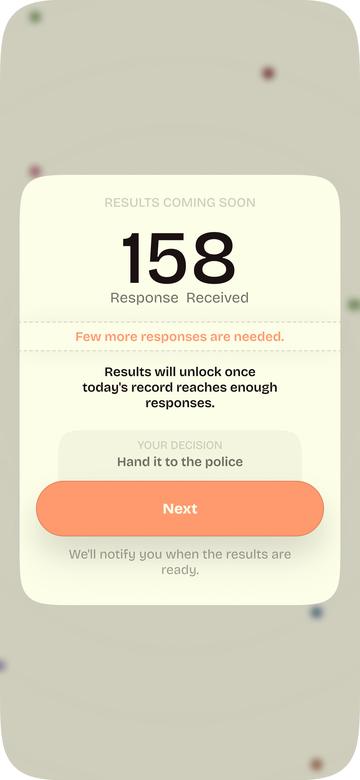
A card still collectingThe count is shown, the aggregate is not. This state is the whole rule made visible.
The number itself
There is not one Min-N.
The threshold is set per reading type rather than as a single site-wide figure, because the thing being protected differs each time.
A public card protects against noise
Here the threshold exists so a national figure is not built from a handful of early answers. It is set high enough that the aggregate is stable rather than merely present.
A circle protects identifiability
In a small group the risk is not noise but exposure. The rule is completeness — every member answers, or the reading does not open — so nobody's position can be read off a partial result.
An institution report protects students
A batch report is produced only when the group is large enough that no individual can be inferred, and subgroups too small for that are not broken out at all.
None of them is zero or one
Whatever the figure is in each case, the rule it enforces is the same: a number does not appear until enough distinct verified people stand behind it.
Should the thresholds be published?
There is a real argument each way. Publishing them lets anybody check that a reading met its own standard, which is the kind of verification this platform otherwise invites. Withholding them makes it harder to time an attempt to push a card over the line with coordinated answers.
What is settled is that the threshold is applied by the system rather than decided per card by a person, so it cannot be lowered for a card somebody is impatient about. Whether the figures themselves become public is a decision that has not been taken yet, and this page will say so until it has.
In one line
The definition.
- Min-N
- The minimum number of verified responses a card must collect before its aggregate may be shown to anybody. Below the threshold nothing about the aggregate is displayed — not a partial figure, not an estimate. The threshold is set per reading type and enforced by the system rather than decided card by card.
What Min-N does not do
- It does not make a card accurate. A threshold protects against a figure being built on too little; it cannot fix a badly written situation.
- It does not hide bad results. Once a card is open, its reading is published whatever it says, and it stays in the record afterwards.
- It does not delay your own answer. Your response is recorded immediately and counts toward the threshold others are waiting on.
- It is not a quality score. Crossing the threshold means enough people answered, not that the reading is interesting.
Questions
Straight answers.
What exactly is Min-N?
The minimum number of verified answers a card must collect before its aggregate can be shown. Until that number is reached, nothing about the aggregate is displayed to anybody, including us. Once it is reached, the full figure appears at once.
What is the actual number?
It is set per reading type rather than as one site-wide figure, because a public card, a private circle and an institution session are each protecting something different. Whether the specific figures should be published is a decision that has not yet been taken, and this page will keep saying so until it has.
Why not show the figure with a warning that it is early?
Because once you have read a number you cannot un-read it. The caveat gets processed as a formality and the figure gets processed as a fact, and what you remember a week later is the figure. Withholding is the only version of that warning that actually holds.
Does my answer count while the card is still closed?
Yes, immediately. It joins the record the moment you submit and counts toward the threshold other people are waiting on. Nothing is held back or re-submitted later.
Will I be told when the card opens?
Once, when it happens. After that nothing — no reminder if you did not open it, no streak, and no second nudge. The card stays readable whenever you choose to return to it.
Can a threshold be lowered so a card can be published sooner?
No. It is applied by the system rather than chosen card by card, so it cannot be adjusted for something somebody is impatient about. That is also why the public readings page has stayed empty rather than being filled with early figures.
How does this work in a circle reading?
The rule there is completeness rather than a count: the reading opens only once every invited member has answered. In a small group the risk is not noise but that a partial result would reveal individual positions, so nothing opens until it cannot.
Does it apply to institution reports?
Yes. A batch report is produced only when the group is large enough that no individual can be inferred from it, and subgroups too small for that are not broken out separately, however much a coordinator might want that breakdown.
Be one of the answers.
Every card that opens for somebody else opened because enough people answered it first.