DemocrezGet the app

One round

One round, start to finish.

A Democrez round has four steps — read, choose, predict, collide — and they always happen in that order. You commit to a prediction about other people before you are allowed to see what other people did. Everything else on this page explains why that single constraint is the whole instrument.

Follow one situation all the way through

The same card, four times.

Below is one real situation from the Money territory, carried through every step exactly as it appears in the app.

01Read

A situation where every option costs something

Every card is written so that whichever way you go, somebody pays. There is no trick, no hidden lesson, and no option that a reasonable person could not defend. If a card has an obvious right answer, it fails review and never reaches you.

Money

You find a wallet with ₹12,000 in cash. Nobody is around.

What you can see at this point: the situation and its territory. Nothing about how anybody else answered — not a count, not a hint, not a trend.
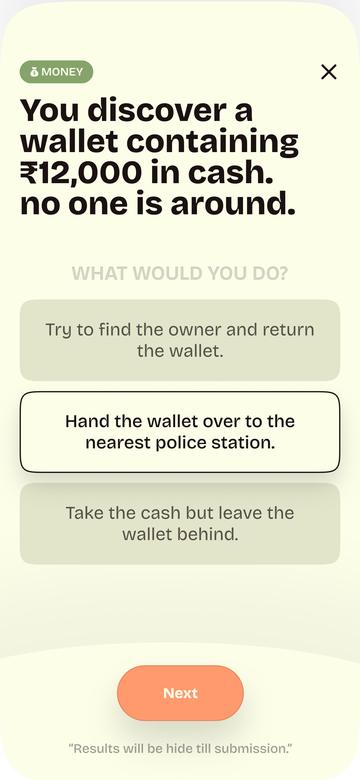
02Choose

What you would actually do

Not what sounds right when said out loud. The options are deliberately written at the same length and in the same register, so neither one reads as the approved answer. Your choice joins an anonymous count and is stored against nothing else.

Option A

Hand the wallet over to the nearest police station.

Costs you: an afternoon, and the wallet may never reach its owner anyway.

Option B

Keep the cash and leave the wallet where you found it.

Costs someone else: the money, and any chance of recovering it.

Why every option carries a cost: this is what gray against gray means. A card where one option is free is not measuring judgment — it is measuring whether you were paying attention. More on gray vs gray

03Predict

Now guess what everyone else did

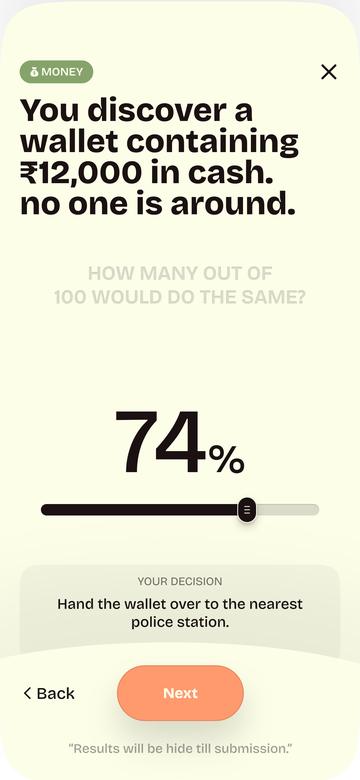
This is the measurement. Everything before it was setup. You state what share of people you think chose the same option as you, and you lock it. Once locked it cannot be edited, and until it is locked no aggregate will appear.

Out of every 100 people who answered this, how many do you think chose the same as you?

34out of 100 — your prediction

Locked · cannot be edited

Why it locks: if you could adjust after seeing the result, the number would record your reaction rather than your reading of people. There would be nothing left to measure.

04Collide

The verified number arrives

The aggregate appears — provided enough verified people have already answered this card. The distance between your locked prediction and that figure is your Gap for this situation. Then the round ends. Nothing is added, ranked or explained away.

Illustrative — not real data

The collision

You find a wallet with ₹12,000 in cash. Nobody is around.

34%You predicted
74%People chose

40points of the Gap. You expected a third of people to hand the wallet in; nearly three quarters did. The number is about the world, not about you. What the Gap means

What does not happen next: no score is calculated, no accuracy percentage is stored, no advice appears, and nothing is compared against other players. Why we stop here

A Democrez situation showing three options, one of them selected

Step 02 — ChooseEvery option written at the same length, each carrying its own cost.

A slider used to set what share of people you think chose the same option

Step 03 — PredictYou set a share and lock it. Nothing about the aggregate is visible yet.

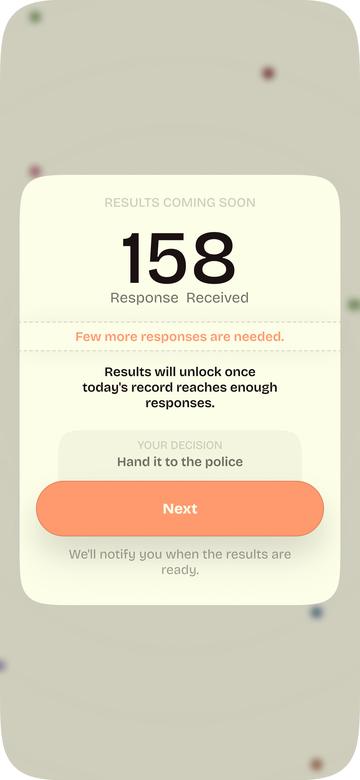
A screen saying results unlock once enough people have answered

If it is too earlyBelow the threshold you see nothing at all, not an estimate.

The number on the other side is people. Every figure you collide with came from verified humans answering the same card alone, without seeing each other or you.

The one constraint

Why the order can never change.

Almost every product that shows you a crowd number shows it too early. You see that 74% of people chose something, and only then are you asked what you think. By that point your answer is contaminated — you are reacting to a figure rather than reporting your own reading of people.

Prediction before revelation

Democrez inverts this. Your prediction is captured and sealed before any aggregate exists on your screen. That is the only reason the resulting gap means anything. Remove the ordering and you still have a poll; you no longer have a measurement.

You cannot go back

A round cannot be replayed for a better result. Once you have seen the aggregate for a card, that card is spent for you — it will not be offered again as a fresh prediction, and your original answer stands permanently in the record.

You cannot see partial results

There is no live counter ticking up while you decide, and no indication of which way the answers are leaning. Progress indicators in group readings show only how many people have finished, never what they chose.

After you answer

Where your answer goes.

Your choice leaves your screen and enters an anonymous record. Three rules govern what happens to it from that moment.

It is appended, never edited

Answers are added to an append-only record. Nothing is overwritten and nothing is deleted. If a card is reworded it becomes a new version rather than replacing the old one. The Reality Bank

It stays hidden until there are enough

No aggregate is shown until a minimum number of verified people have answered that card. Below the line you see nothing rather than a misleading figure. Min-N

It is never joined by an invented one

No AI writes, fills, smooths or estimates responses. The number you meet is made only of answers real people gave. No fake reality

The card itself was approved by a person

Situations are drafted with AI assistance and then signed off by a human before they can reach anybody. No card publishes itself. The Human Seal

Same round, three settings

Alone, with someone, or with a batch.

The four steps never change. What changes is who the aggregate is drawn from, and who it belongs to afterwards.

 AloneTogetherInstitution
Who answersYou, plus everyone else who has met this cardYou and the people you invitedA verified batch in one session
When the result appearsOnce Min-N is metOnce every invitee has answeredOnce the session closes
What you seeYour own Gap against the national aggregateThe group's collective mirrorYour own Gap, privately
What the organiser seesNothing — there is no organiserThe same mirror everyone else seesAn aggregate report, no individual named
Where the data goesReality BankReality BankInstitution report only — never the Reality Bank

How pair and circle readings work →

Questions

Straight answers.

Can I change my prediction after seeing the result?

No. The prediction locks the moment you submit it, and the aggregate only becomes visible afterwards. A prediction that could be edited after the reveal would record your reaction rather than your reading of people, which would make the gap meaningless.

What if I answer a card twice?

You cannot. Once you have seen the aggregate for a card, that card is spent for you. It will not be offered again as a fresh prediction, and your original answer stands permanently in the record.

How long does one round take?

Under two minutes for most people. There is no timer, no penalty for thinking longer, and no reward for finishing quickly — speed is not part of what is being measured.

What happens if not enough people have answered?

You see nothing at all. Democrez withholds the aggregate entirely until a minimum number of verified responses exists for that card. A percentage built on a handful of answers looks authoritative and is not, so silence is the honest output. This rule is called Min-N.

Does a large Gap mean I failed?

No. A large gap means the population behaved differently from your expectation — which is information about the world, not a verdict on you. Democrez does not grade the gap, does not track it as a score, and does not tell you to reduce it.

Can I see how other individuals answered?

No. Answers enter an anonymous aggregate and nothing else. There is no profile to browse, no follower list, and no record connecting a choice back to a person — including in pair and circle readings, where the group sees a collective picture rather than individual answers.

Run your first round.

One situation a day, across eight territories. Your prediction, locked. Then the number.