

Why there is no right answer
Gray against gray.
No situation on Democrez has a correct answer, because every option is written so that somebody real pays for it. A card where one choice is obviously right would measure whether you can read, not how you judge — and it would tell us nothing about people, because almost everyone would pick the same thing and almost everyone would predict that.
What makes a situation gray.
The phrase comes from the shape of the material rather than from ethics. A black-against-white situation has a defensible option and an indefensible one; a gray-against-gray situation has options that are all defensible and all expensive. Somebody is worse off whichever way you go, and the disagreement between people is about who.
That property is what makes the measurement possible. If a card splits people, the split is information. If a card does not split people, the aggregate is a foregone conclusion, your prediction of it is a foregone conclusion too, and the distance between them — the number this entire platform exists to report — collapses to nothing.
The test a situation has to pass
Before a card is sealed, somebody has to be able to argue for every option without dishonesty. Not argue well, not argue persuasively — argue at all, from a position a reasonable person could actually hold. If one option can only be defended by pretending, the card fails and does not enter the deck.
The second test is quieter and catches more cards: the options have to be written in the same register. A choice described warmly and at length, sitting next to a choice described curtly, is not a gray card. It is a right answer wearing a disguise, and people spot the disguise instantly — which means what gets recorded is their reading of the writing, not their judgment of the situation.
What this rules out
A great deal, and deliberately. Anything with a legally clear answer is out, because the law has already made the choice. Anything with a factually clear answer is out, because that is a quiz. Anything where one option harms a person and the other harms nobody is out, because that is not a dilemma; it is a temptation, and measuring temptation tells you about willpower rather than about how people weigh competing obligations.
Situations designed to make people look bad are also out. A card written so that the honest answer is embarrassing will collect dishonest answers, and dishonest answers are worse than no answers — they look identical to real ones in the aggregate.
Why this is harder than it sounds
Gray is not a fixed property of a situation; it depends on who is reading it. A card about family obligation that is genuinely difficult in one household is obvious in another. A card about workplace credit that splits people in one industry is settled in another. Perfect grayness across an entire population does not exist, and claiming otherwise would be its own kind of dishonesty.
What is achievable is narrower: a card that a reasonable person could go either way on, written without a thumb on the scale. When a card turns out to be less gray than intended, the aggregate says so — the split is lopsided — and that reading stays in the record rather than being quietly withdrawn.


Grayness is measured by disagreement, not declared. A card is gray if real people who read it carefully still land in different places.
In practice
Four cards, and what
each option costs.
Below are situations from four territories. In each one, name the option you think is obviously correct — then read what it costs somebody.

Money
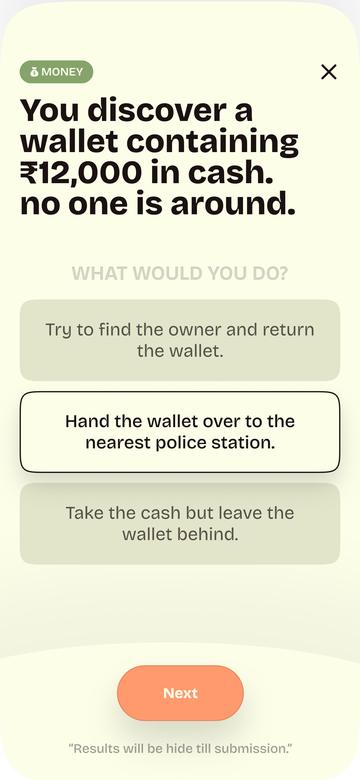
You find a wallet with ₹12,000 in cash. Nobody is around.
Hand it in and it may never reach the owner. Track them down and it costs you a day. Keep it and somebody loses a month.

Career
One teammate did no work. Everyone receives equal credit.
Say nothing and the others carry it again next time. Say something and you decide someone's standing on incomplete information.

Relationships
Your closest friend asks for your honest opinion about their partner.
Answer honestly and you may not be forgiven for it. Soften it and you have been asked for one thing and supplied another.

Family
A family expectation costs you an opportunity you may not get again.
Go and something of yours closes quietly. Stay and somebody who has never asked before was told no.
Every territory is built on this. See all eight
Review
What gets in, and what gets thrown out.
Every card is drafted with AI assistance and then reviewed by a person before it can reach anybody. Most of that review is this one judgement, applied over and over.
| Fails review | Passes review | |
|---|---|---|
| The choice | One option is defensible, the others are not | Every option can be argued for honestly |
| The writing | One option written warmly, another curtly | Same length, same register, no thumb on the scale |
| The cost | One option harms somebody, another harms nobody | Somebody real pays whichever way you go |
| The subject | Settled by law, or by a fact you can look up | Settled by nothing — which is why it is here |
| The effect | The honest answer is embarrassing to give | Any answer can be given without shame |
Same length, same registerNone of the options is dressed up as the approved one.
In one line
The definition.
- Gray vs gray
- A situation in which every available option carries a real cost to somebody, so that no option can be called correct. Situations with a defensible answer and an indefensible one are rejected before they enter the deck.
It protects the split
A card only produces information if people land in different places. Grayness is the property that makes disagreement possible at all.
It protects honesty
Where no answer is shameful, people answer as themselves. Where one is, they answer as the person they would like to be seen as.
It protects the Gap
If everyone chooses the same thing and everyone predicts that, the distance between prediction and reality is zero by construction. The Gap
It keeps us out of it
A platform that decided which answer was right would be publishing its own view under the cover of a measurement.
Questions
Straight answers.
Is gray vs gray the same as moral relativism?
No. It is a rule about what belongs in the deck, not a claim that all choices are equally good. Plenty of situations have a clear right answer; those are excluded precisely because they are clear, since a card everyone agrees on cannot measure how people differ.
What if I think one option obviously is correct?
Then you have found something useful, and the aggregate will tell you whether other people agree with you about that. Often they do not, and the size of that surprise is the reading. A card feeling obvious to you is not the same as it being obvious.
Who decides whether a card is gray enough?
A person, before release. Cards are drafted with AI assistance and reviewed by a human who has to be able to argue for every option honestly. If they cannot, the card does not ship. That review is recorded as the Human Seal.
What happens if a card turns out to be lopsided anyway?
The reading stays. A card that split people far less evenly than intended is itself a finding, and the record is append-only, so nothing is withdrawn because it was unflattering to the person who wrote it.
Are political and religious situations included?
No. Those disagreements are real, but a platform measuring them would be read as taking a side no matter how the cards were written, and the answers would become declarations of identity rather than accounts of what somebody would do.
Does every card have the same number of options?
Not necessarily. What is fixed is that each option carries a real cost and none is written as the approved one. The count varies with the situation; the rule does not.
Find a card you cannot call.
One situation a day, from the eight territories. Every option costs somebody something.